So you know what you'd be getting, the below text is the entirety of the book's preface, describing its scope and its creation. You may also be interested in my first extensive post on the book, which includes several images of the its interior. Click here to find out where you can procure your own copy of this unique reference work.
Preface
Put simply, this book is a daily history of the Disneyland Resort, providing Park hours, weather, and significant events for both Disneyland Park and Disney California Adventure since July 17, 1955. We have defined significant events as openings and closings of attractions, restaurants, and stores; debuts, endings, and dedications; entertainment events, television airings, and important visitors; and occurrences such as accidents and Resort expansion news. We have not included Cast Member events (such as holiday parties, blood drives, Canoe Races, and Cast previews of new attractions). Neither have we included the finer details of entertainment events, such as the specific dates each year that the Main Street Electrical Parade or A Christmas Fantasy Parade
performed.
My first act of historical scholarship was the creation of a Disneyland Timeline in late 1995 that in the late 1990s resided on the World Wide Web; this project is a natural outgrowth of that. The original timeline predated Dave Smith’s Disney A-Z and only featured what I would now consider to be a smattering of openings, closings and debuts at the month level, with information drawn largely from Bruce Gordon and David Mumford’s Disneyland: The Nickel Tour and some Internet sources. I subsequently refined the timeline over the next five years with the many details in Disney A-Z, The “E” Ticket magazine, other new publications and my own personal knowledge from frequent trips to Disneyland.
The various terms have been output as they come from the Disneyland Thesaurus (described below). Occasionally, for purposes of distinguishing two otherwise identically named entities, terms are appended with an identifier in parentheses. For example, in the Almanac there are entries for Mr. Toad’s Wild Ride (1955-1982) and Mr. Toad’s Wild Ride (1983- ). Sometimes we are unsure of an opening or closing date, and the parentheses will thus contain one or two question marks.
We do not always have an exact date that an attraction opened or a store closed. We have been as specific as our knowledge permits, but occasionally have had to indicate that something happened at the more general month or year level. This reflects the inherent uncertainty in trying to precisely reconstruct the past.
Jason’s Disneyland Almanac has been created from the ground up, rather than drawn from an existing comprehensive history of the Resort. Because of this process, there are certainly omissions. Some of the omissions occur because we do not have good information on an opening or closing date and some may be for an event which occurred so briefly that we have yet to find it mentioned in one of our many sources. We have included the dates when Grad Nites and Candlelight Processions & Ceremonies were held, when known, but for some years we do not have this information. For further details on how the data for the Park hours, the weather, and Walt-era attendance were assembled, see the following sections.
About the Hours
We are aware that no independent effort to reconstruct Park hours through the years can ever achieve 100% accuracy. Park hours could be extended or shortened in response to crowd levels and not be documented in a source that will ever be made public. As far as possible we have compared as many documents containing Park hours for a specific day. Although we do have documentation for some days Disneyland closed early or entirely because of rain, the Park hours here assembled should be considered a best compilation of the scheduled hours, rather than the operational hours.
Park hours have come from newspaper advertisements, newspaper articles, periodicals (such as the Disney News and Vacationland), guidemaps, Main Gate handouts, Park Operating Calendars, Cast Member fact cards, Entertainment Show Schedules, Cast Member Reference Guides, Disneyland Attendance Summary 1955-1966, and online sources (such as LaughingPlace.com and MousePlanet.com). Especially in years past, Disneyland would publish its hours many months into the future. We have always shown preference to sources issued closest to the date in question and those produced by Disney rather than appearing in external sources (as the external sources are at least one step removed from Disney).
We are missing Park hours for 773 of the 20,257 days covered by this Almanac. The first such day is February 12, 1984 and the last is June 30, 1999; the missing days are mainly concentrated in the late 1980s and early 1990s. While they are presently unknown to us, they are certainly not unknowable. They may be found in the entertainment section of newspapers, handouts from the Main Gate, Cast Member Reference Guides and Entertainment Show Schedules. If you have documentation for any of the missing hours (marked in this Almanac as “Unknown”), you can contact me at Progressland@gmail.com. [Online addendum: See www.dropinagain.com/missinghours.txt for the current list.]
About the Weather
In a perfect world, the weather data we draw on would be an unbroken climate record from 1955 to the present at a station in Disneyland (perhaps in the Central Plaza). The next best thing is to find a nearby climate station whose weather is similar to Disneyland. The Fire Station at 120 West Walnut St., Santa Ana (NWS ID: STAC1) is close to Disneyland (5.5 miles away), about thirty feet lower in elevation (not much), is only about a mile closer to the ocean, and has records dating to the early 20th century.
However, no climate station of any reporting length has perfect records, so I had to search for backup stations for when the Fire Station didn’t report data (about 500 days over the course of 55 years). In ranked order in terms of similarity to Disneyland’s weather, I chose:
• Tustin Irvine Ranch: records until 7/31/2003, when it was replaced by the station named Irvine Ranch. It tended to run a few degrees warmer than the Santa Ana Fire Station during the day and usually more than a few degrees cooler at night. Casual analysis showed it may have received more precipitation, as well. At 235 feet in elevation, it’s not too much higher than Disneyland.
• Anaheim: This might seem like a more natural first choice for evaluating Disneyland’s weather, but the station only began operation on August 1, 1989. While the station name is Anaheim, it is actually in Atwood, north of CA-91 and east of CA-57; its further inland location means it will generally run warmer than the Santa Ana Fire Station (and Disneyland).
• Irvine Ranch: This station succeeded the Tustin Irvine Ranch station as of 8/1/2003, but is much higher in elevation (540 feet). My assumption is that the old Irvine Ranch station was done in by suburbanization.
Even with all that data, there were still 29 dates for which I had no data. I used Long Beach Daugherty Field (LGB) as my last resort. It’s quite a bit closer to the ocean and not as close to Disneyland as I would like, but it has a lengthy reporting record that filled in when necessary. Unlike the other stations above, I only included LGB information for those days with otherwise missing data.
A note is also in order about the reporting times for this data. The information was often collected at 6 PM. As the low temperature would normally (but not always) occur in the early morning hours and the high temperature in the afternoon, these figures will usually match up with the calendar day. However, precipitation can occur at any time and there is no way now to tell, in a 6 PM-6 PM reporting cycle, how much rain fell on which particular calendar day.
This is certainly not a climate record usable for scientific research purposes, but provides color to the daily history. For example, you can see that the high on Opening Day was 82°F, not quite as hot as is generally remembered. Or you can see that the heat wave at the end of 1955’s summer really was rough: for eight days, from August 31 to September 7, the high temperature was 97 degrees or higher, with a peak of 108 degrees on September 1. The highest recorded temperature between July 17, 1955 and December 31, 2010 was 111°F, measured on September 27, 2010, and the lowest was 27°F, on February 5, 2003. 724.88 inches of rain fell on Disneyland in this period, with the heaviest rain occurring on January 26, 1956 (4.22 inches) and 18,071 of the 20,257 days experiencing no rain at all.
About the Attendance
I had always talked about what came to be titled Jason’s Disneyland Almanac as a book you would want to have in your time traveling DeLorean. With the weather, Park hours, famous visitors, and information on events, you could almost know exactly what to expect for that day. But it always felt impoverished without also seeing the day’s attendance. I had resigned myself to the knowledge that Disney carefully guards such information and would thus never be able to include it in the Almanac—and then discovered that the Anaheim Heritage Center at the MUZEO had possession of Roy O. Disney’s Disneyland Attendance Summary, dated July 18, 1955-December 31, 1966. More than just the daily attendance, this thick binder includes hourly attendance for almost all of these days, and notes of which days the Park closed early or entirely due to weather. There are two pages/weeks missing from the binder (those beginning February 28, 1965 and May 29, 1966), but otherwise includes all attendance data from Walt Disney’s lifetime.
Most of the 1955 data includes hourly attendance. Beginning January 11, 1956, each date has three unlabeled columns, which provide the cumulative attendance, the cumulative exit count, and the hourly in-Park count. Occasionally these numbers show the logically impossible, as on October 17, 1956, when the total attendance was 4,588, but the cumulative exit count was 5,656. Each of the pages includes a weekly total, so whenever a day has such an anomaly, we have ensured that our daily attendance figures add up to that weekly total. Although the binder includes attendance counts for special events, such as Dixieland at Disneyland and New Year’s Eve Parties, such information was not part of the regular daily attendance figures and so are not included in this Almanac.
The figures reveal some astonishing things about Disneyland’s early years. Weekday attendance in the off-season hovered in the low thousands, plainly indicating the wisdom of the Park’s closing on Mondays and Tuesdays for maintenance reasons. The lowest attended day during this period saw just 389 visitors, on a rainy January 20, 1962 when Disneyland opened for a total of three hours. In the rainy week beginning February 5, 1962, Disneyland opened for one full and two partial days and had a mere 7,424 Guests. The rain even had a tremendous impact during the traditionally busy week between Christmas Day and New Year’s Day. In December 1965, when Disneyland was already well-established, the dry December 28 saw 42,633 visitors, the rainy December 29 a mere 4,367, and the less rainy December 30 48,526.
Conversely, in the summer of 1959 Disneyland smashed its previous attendance records. On July 4, 1959 the Park hosted 59,845 Guests. The previous high attendance day came just a few weeks earlier, on June 20, when 45,673 people visited the Park—showing a 30% increase of the highest attended day in an incredibly short period of time. The highest attended day during this period was July 4, 1964, when 60,917 visitors came to Disneyland.
About the Index
Items were added to the index using natural-language search terms when possible. A single search term is used even when multiple locations shared a similar name, such as the Fantasyland Theatre. All openings and closings of major locations—attractions, shops, and restaurants—should be included in the index. However, the index is not meant to be comprehensive in every respect. Smaller parades, entertainment, and events, especially if they occurred only once and in the distant past, are more likely to be omitted. Events that occurred year after year, such as Grad Nite or Candlelight Procession & Ceremony, were listed only upon first introduction, to avoid cluttering the index.
About the Thesaurus and Compendium
In late 1999, Kevin and I worked up the idea for the ultimate Disneyland reference work, something we refer to as The Disneyland Compendium. At the time, we did not have access to the information resources to make the project viable. Published resources like Disneyland: The Nickel Tour and The “E” Ticket magazine were tremendously informative, but we knew an extraordinary amount of detail was to be found in the decades of Cast Member publications, periodicals like Vacationland and The Disney Magazine, in the stories of Cast Members, and in many items besides we simply did not have easy access to, and so the project went on indefinite hold.
Jumping forward, my friend Kim T. Ha and I took an index language construction class in fall 2006. Unable to agree on a topic (a common problem), we fell back to an old Disneyland “land tree” I had tried to make. That finished thesaurus had a couple thousand terms in it, but was mainly just hierarchically arranged terms, with some cross-references. Aside from the source where we found the term, this thesaurus had little additional information on the terms and concepts.
On August 19, 2007, I came across the great vintage Disneyland blogs I had only previously seen in passing, and knew that things were now aligned for me to pursue my Disneyland interest with renewed vigor: I had the basis of knowledge (from all my previous years reading everything I could), I had the skill set to create the thesaurus (from my library science schooling), and I had a phenomenal sea of historical information (now easily accessible) to draw from. That first day I think I saved a few thousand vintage photos to my computer.
I toiled alone at first. I showed a barebones printed output to people for the first several months (the earliest Thesaurus showing on record is October 25, 2007, at the Café Orleans). As I worked on the Thesaurus, I realized my initial idea, to just have a hierarchy and cross-references, wasn’t working. I’d forget how I came to relate two terms together, or how I had chosen one among several possible variants to use as the preferred term. So I started sourcing everything. And then I began including full text, all while carefully tracking what I had available to me, what I knew to exist somewhere, and what I had already gone through. Once I made that decision, the usefulness of the Thesaurus to me expanded by leaps and bounds.
Wanting to be part of the conversation, driven in large part by the other blogs that updated every day, I began my own blog, Disneyland Nomenclature, on March 18, 2008. I shared some personal stories and talked about the Thesaurus. In early 2009, while on a 76-day vacation, I decided to make a daily history of the Resort a part of my effort. On an eleven-day weekend from the Washington, D.C. snowstorms of February 2010, I threw the weather into the mix.
In sum, the Disneyland Thesaurus is the informal research program and backend database that organizes the information; the Disneyland Compendium is an umbrella term for products derived from Thesaurus data. Jason’s Disneyland Almanac is the first such product.
Acknowledgments
This book would not have been possible without the assistance of the vintage Disneyland blogging group. Rev Vandervort, in particular, proved particularly enthusiastic about providing many previously missing hours from the 1990s. Timothy Youel, Patrick Jenkins, Mike Cozart, Kevin Doherty and Ken Stack also answered the call for help with hours. But the book isn’t just about the hours. As it is a detailed representation of the first 55 years of Disneyland’s history, the details I’ve picked up from reading blogs run by David Eppen, Dave DeCaro, Jed Blaugrund, Kevin Kidney, Chris Sandy, Paul F. Anderson and Todd J. Pierce have contributed immeasurably to this book and to the Thesaurus. The Park hours preserved by the MousePlanet.com Disneyland Park Updates (largely authored by Adrienne Vincent-Phoenix) and provided to me by Doobie and Rebekah Moseley of LaughingPlace.com were invaluable. Jane Newell at the Anaheim Heritage Center helped me to quickly locate and use the amazing Disneyland Attendance Summary binder held there.
When I was first working on my Disneyland Timeline in the 1990s, Dave Smith at the Walt Disney Archives replied to seemingly endless queries about opening and closing dates of obscure shops and restaurants. My aunt and uncle, longtime Disneyland Cast Members Mary and Roy Masseth, in 1997 provided me with years’ worth of Disneyland Lines. Many of these had information useful in the construction of this Almanac. Another former Cast Member, Earl Archer, graciously allowed me access to his extensive collection of Cast Member materials.
Thanks, especially, to Kim T. Ha for taking that index language construction class with me and helping to create the earliest Thesaurus, and to my parents Melody and Hal and siblings Charles and Marcie for their support and rides to Disneyland given to me in those dark days before I got my driver license.
Jason Schultz
Anaheim, CA
September 2011
Showing posts with label Jason's Disneyland Almanac. Show all posts
Showing posts with label Jason's Disneyland Almanac. Show all posts
Monday, November 14, 2011

Friday, November 11, 2011
Where to Get Jason's Disneyland Almanac
 Many people who visit this blog ask, "When and where can I buy a book like this one?" (say in your best Monsanto narrator voice). I am here to tell you, friends, when and where this can be done.
If you are interested in one of the hardcovers (limited edition of 150):
- Contact me directly using the e-mail address in my profile. I can ship it to you or we can make plans to meet up at the Disneyland Resort.
$24.95 through our CreateSpace storefront$24.95 through Amazon.com$24.95 at Compass Books in Downtown Disney$20, including tax, in person, if you know me in real life or want to meet up at Disneyland- Potentially free, if you can help us with some of the 773 missing Park hours
- Contact me directly
Related posts of interest:
Wednesday, November 9, 2011
ID That Clock (Answers)
OK, by now you've all had enough time to figure out all the clocks, right? (If you're stumbling upon this and don't want SPOILERS, go to the original post now.) All of the bolded answers are clocks which nobody at the party could correctly identify.
We'll start with the mostly modern (and all On Stage) answers first:
 1 - Innoventions Dream Home (Office)
2 - McDonnell Douglas Rocket to the Moon (bonus if you could identify ROSEANN PIRUS)
3 - City Hall Quiet Room (room south of the main lobby)
4 - Main Street Clock
5 - Peter Pan's Flight Interior
 6 - Mickey's Toontown City Hall
7 - Fortuosity Shop Exterior
8 - Bibbiddi Bobbidi Boutique Exterior
9 - Disney Clothiers Interior
10 - Haunted Mansion Holiday Exterior
11 - Crystal Arts Interior
 12 - Haunted Mansion Holiday FASTPASS Return
13 - Mural outside The Disney Gallery, Main Street, U.S.A.
14 - Fortuosity Shop (Jewelry Store) Interior
15 - Buzz Lightyear's Astro Blasters FASTPASS Return
 16 - The Many Adventures of Winnie the Pooh
17 - Emporium Interior
18 - Port Royal Interior
19 - Fire Station
20 - Innoventions Exterior
 21 - "it's a small world" Facade
22 - 20th Century Music Company Window
23 - Enchanted Tiki Room Lanai
24 - French Market Restaurant
25 - Main Street Station
 26 - City Hall Interior
27 - White Rabbit at "King" & "Queen" Restrooms
28 - Emporium Ratatouille Window
29 - Fortuosity Shop (Jewelry Store) Interior
30 - Main Street Magic Shop Interior
31 - Innoventions Dream Home (Kitchen)
32 - Sleeping Beauty Castle
33 - Port Royal Interior
 34 - City Hall Interior
35 - Splash Mountain Entrance
36 - Mickey's House Interior
37 - Fortuosity Shop Interior
38 - Peter Pan's Flight Exterior
 39 - Main Street Station Interior
40 - Fortuosity Shop Interior
41 - Mickey's House Interior
42 - Space Mountain Entrance
43 - Emporium Window
44 - Central Plaza White Rabbit
And now, the Expert Edition answers (as given in the August 1961 Disneylander)...
 E-1 - Tomorrowland entrance
E-2: Swift's Market House
E-3: Santa Fe & Disneyland R.R. Station
E-4: In front of Timex Shop
E-5: Tower of Tinkerbell Toy Shop
E-6: Mark Twain Dock
E-7: Rainbow Ridge Mining Town
E-8: Inside the Emporium, Main Street
E-9: Bell System Exhibit
E-10: Pirate Ship
E-11: Dick Nunis' wrist
E-12: Joe Fowler's desk
E-13: Bank of America
E-14: Harbor Blvd. Time Clock House
E-15: Watchman's clock used in Security
E-16: Tinkerbell Toy Shop
So...how'd you do?
We'll start with the mostly modern (and all On Stage) answers first:
 1 - Innoventions Dream Home (Office)
2 - McDonnell Douglas Rocket to the Moon (bonus if you could identify ROSEANN PIRUS)
3 - City Hall Quiet Room (room south of the main lobby)
4 - Main Street Clock
5 - Peter Pan's Flight Interior
 6 - Mickey's Toontown City Hall
7 - Fortuosity Shop Exterior
8 - Bibbiddi Bobbidi Boutique Exterior
9 - Disney Clothiers Interior
10 - Haunted Mansion Holiday Exterior
11 - Crystal Arts Interior
 12 - Haunted Mansion Holiday FASTPASS Return
13 - Mural outside The Disney Gallery, Main Street, U.S.A.
14 - Fortuosity Shop (Jewelry Store) Interior
15 - Buzz Lightyear's Astro Blasters FASTPASS Return
 16 - The Many Adventures of Winnie the Pooh
17 - Emporium Interior
18 - Port Royal Interior
19 - Fire Station
20 - Innoventions Exterior
 21 - "it's a small world" Facade
22 - 20th Century Music Company Window
23 - Enchanted Tiki Room Lanai
24 - French Market Restaurant
25 - Main Street Station
 26 - City Hall Interior
27 - White Rabbit at "King" & "Queen" Restrooms
28 - Emporium Ratatouille Window
29 - Fortuosity Shop (Jewelry Store) Interior
30 - Main Street Magic Shop Interior
31 - Innoventions Dream Home (Kitchen)
32 - Sleeping Beauty Castle
33 - Port Royal Interior
 34 - City Hall Interior
35 - Splash Mountain Entrance
36 - Mickey's House Interior
37 - Fortuosity Shop Interior
38 - Peter Pan's Flight Exterior
 39 - Main Street Station Interior
40 - Fortuosity Shop Interior
41 - Mickey's House Interior
42 - Space Mountain Entrance
43 - Emporium Window
44 - Central Plaza White Rabbit
And now, the Expert Edition answers (as given in the August 1961 Disneylander)...
 E-1 - Tomorrowland entrance
E-2: Swift's Market House
E-3: Santa Fe & Disneyland R.R. Station
E-4: In front of Timex Shop
E-5: Tower of Tinkerbell Toy Shop
E-6: Mark Twain Dock
E-7: Rainbow Ridge Mining Town
E-8: Inside the Emporium, Main Street
E-9: Bell System Exhibit
E-10: Pirate Ship
E-11: Dick Nunis' wrist
E-12: Joe Fowler's desk
E-13: Bank of America
E-14: Harbor Blvd. Time Clock House
E-15: Watchman's clock used in Security
E-16: Tinkerbell Toy Shop
So...how'd you do?
Tuesday, November 8, 2011
ID That Clock
Over the weekend I hosted a book launch party for Jason's Disneyland Almanac (I hope to have photos of that up soon). One of the entertainments that evening was a clock identification game, with the winner entitled to a free copy of the book (or, since the results weren't going to be tallied that night, a refund on a book already purchased). The brave contestants could rely only on their wits; you have the entire universe at your fingertips (which is why you can't win a free book--sorry!).
I had assembled 44 clock photos, 42 of which are current On Stage photos, before discovering just such a game in the June and July 1961 Disneylanders. Afraid that more than one person might know all the current photos (an unnecessary worry, I learned), I included these 16 photos as an "expert edition" of the game. Go ahead and have fun in the comments. I'll post the correct answers in a day or two. Should you wish to concentrate on the difficult ones, nobody correctly identified the following: 1, 3, 13, 18, 22, 28, 30, 40, 43, E-7, E-10, E-11, E-12, E-13, E-15, E-16.
The clock is ticking!
I had assembled 44 clock photos, 42 of which are current On Stage photos, before discovering just such a game in the June and July 1961 Disneylanders. Afraid that more than one person might know all the current photos (an unnecessary worry, I learned), I included these 16 photos as an "expert edition" of the game. Go ahead and have fun in the comments. I'll post the correct answers in a day or two. Should you wish to concentrate on the difficult ones, nobody correctly identified the following: 1, 3, 13, 18, 22, 28, 30, 40, 43, E-7, E-10, E-11, E-12, E-13, E-15, E-16.
The clock is ticking!Monday, October 10, 2011
Now You Know
 Jason's Disneyland Alamanc was created mainly with mail merge (and a formatting macro I created). But I had never used mail merge, or was aware of its capabilities, before I was trying to figure out how it might be possible to create a daily history of Disneyland on the evening of March 15, 2010 (a red-letter day in the history of Disneyland historiography). That night I played around around in Microsoft Word and, for the first time, output a rudimentary daily history of the Park.
But that's not what this post is about. Rather, my desire for such a history of Disneyland helped to move Richard Nixon's Presidential materials across the country. As a result of Congress amending the Presidential Recordings and Materials Preservation Act of 1974 (PRMPA), the National Archives was moving the Nixon Presidential Historical Materials from the Archives II facility in College Park, MD to the Nixon Library in Yorba Linda, CA--and I was in charge of the details. In August 2009, I had worked with a colleague on a way we might print the move labels for over 26,000 boxes, but I wasn't completely satisfied with how they looked from a Microsoft Access report. I knew that these labels would be permanently affixed to the boxes, and I wanted them to look right. We had some time, so I put it out of my mind.
March 16, 2010 (about two weeks before we were to begin putting the boxes on pallets, to then load on to the trucks), I came into work and told myself I needed to finally come to a decision about how to produce the move labels. I hadn't been at work long before I thought to myself, "mail merge!" It didn't take too much time to create a template and get my managers to sign off. These move labels were then produced and applied to the over 26,000 boxes (enough to fill 21 53' trailers) that traveled to California, supplying a Move ID for each box and its California shelf destination.
 For many years to come most of the archival boxes at the Richard Nixon Presidential Library and Museum will bear labels produced from the same process that birthed Jason's Disneyland Almanac.
Thursday, September 29, 2011
Disneyland Statistics: Interesting Subject
"Hi, folks! It's a little quiet around here today. You see, during the winter, Disneyland is closed each Monday and Tuesday..."- undated Main Gate announcement
It's been a little quiet around this blog, too, but I'm finally ready to announce why: in November Zauberreich Press will publish Jason's Disneyland Almanac, the first daily history of Disneyland. The contents of the publication won't surprise anybody with even a cursory familiarity with my blog: Park hours, weather, Walt-era attendance, openings, closings, debuts, endings, events, milestones and other noteworthy occurrences. I collaborated with Kevin Yee, with whom I previously co-authored the Disneyland trivia books Magic Quizdom: Disneylandia Minutiae Semper Abusrda and 101 Things You Never Knew About Disneyland: An Unauthorized Look at the Little Touches and Inside Jokes.
I've talked about many elements of the book in blog posts of days gone by. I've blogged about Park hours on more than one occasion. I blogged about my attempts to gather weather information shortly after I added that to the thesaurus. I've additionally blogged about the difficulties inherent in thesaurusing entertainment events. With that in mind, I wanted to give you readers some insight into the cover design and the preparation of the manuscript.
 For many of you, the design will be instantly recognizable. However, I have at least two friends who have not seen the movies, so some explanation is in order. I always thought of this book as a companion to keep in your time traveling DeLorean. With the Park hours, the weather, and events, you could choose the perfect day to visit the Park. The cover design is, of course, very reminiscent of Grays Sports Almanac from Back to the Future Part II:
 I imitated the design as much as possible while trying to stay true to what Jason's Disneyland Almanac actually contains. I regret that we still lack Park hours for 773 of the 20,257 days covered by the Almanac, but am very hopeful that these will be found before future versions are published.
For the place of the sports figures, we considered Disneyland icons, but that wouldn't quite match up with the contents of the Almanac. While each figure on the Grays cover represents a different sport found within, we would need to have some objects that represented Park hours, openings, and events. Instead we went with the style of Park Operating Calendars used from the 1960s at least through the 1980s. Here is an example of an authentic January-March 1982 Park Operating Calendar:
 The four calendars on the cover are for Disneyland's opening, Kevin's birthday, my birthday, and the most recent time period covered by the Almanac. I spent a lot of time re-creating the look of the calendars in full for the cover, but they are mostly obscured in the final composite. Below are my original creations for the four Park Operating Calendars:
 July-September 1955
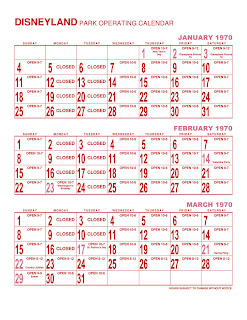 January 1970-March 1970
 January-March 1982
 October 2010-December 2010
I considered creating these for every three-month period of the Park's history, but then came to my senses.
I also wanted to share some samples from the book, so you know just what to expect. After a few pages of explanation of how the material for the book was assembled and how you should evaluate the information, there are 317 pages of daily Disneyland history. Below are three two-page spreads, chronologically scattered. The first covers the time around the opening of Disneyland '59:
 The beginning of celebrations for Disneyland's 25th Anniversary:
 And the opening of Disney's California Adventure in 2001:
 Now, if you've been paying attention, you might notice that the Almanac includes attendance data for 1955-1966. Amazingly, the Anaheim Heritage Center at the MUZEO has in its collection Roy O. Disney's Disneyland Attendance Summary, July 18, 1955-December 31, 1966 binder. Not just daily attendance, it's a record of hourly attendance for most of this period. When matched up with the weather and other events, the attendance data provides a remarkable view of Disneyland in Walt's life (although two weeks, beginning February 28, 1965, and May 29, 1966, are missing from the binder).
 The least-attended day in this period was a rainy January 20, 1962, when a mere 389 Guests showed up to experience a Disneyland that only opened for three hours that day (can you imagine?). There were, in fact, thirteen sub-1,000 visitor days in Walt's life, and quite a few days when the Park simply didn't open because of the rain. The high attendance during this time was July 4, 1964, when 60,917 visitors came to Disneyland.
I've had a lot of fun putting this book together, but I know it's only a start. We do not always have an exact date that an attraction opened or that a store closed. We have been as specific as our knowledge permits, but occasionally have had to indicate that something happened at the more general month or year level. This reflects the inherent uncertainty in trying to precisely reconstruct the past.
We are producing a limited edition of 150 hardbound copies (with dust jackets) and an unlimited run of softcover copies (sans dust jacket). Check back for further information on pricing and availability. And if there's a future Jason's Disneyland Almanac almanac keeper out there, the order for the hardcover edition of the book was submitted on September 29, 2011 at 2:46:57 PM, PDT.
I've talked about many elements of the book in blog posts of days gone by. I've blogged about Park hours on more than one occasion. I blogged about my attempts to gather weather information shortly after I added that to the thesaurus. I've additionally blogged about the difficulties inherent in thesaurusing entertainment events. With that in mind, I wanted to give you readers some insight into the cover design and the preparation of the manuscript.
 For many of you, the design will be instantly recognizable. However, I have at least two friends who have not seen the movies, so some explanation is in order. I always thought of this book as a companion to keep in your time traveling DeLorean. With the Park hours, the weather, and events, you could choose the perfect day to visit the Park. The cover design is, of course, very reminiscent of Grays Sports Almanac from Back to the Future Part II:
 I imitated the design as much as possible while trying to stay true to what Jason's Disneyland Almanac actually contains. I regret that we still lack Park hours for 773 of the 20,257 days covered by the Almanac, but am very hopeful that these will be found before future versions are published.
For the place of the sports figures, we considered Disneyland icons, but that wouldn't quite match up with the contents of the Almanac. While each figure on the Grays cover represents a different sport found within, we would need to have some objects that represented Park hours, openings, and events. Instead we went with the style of Park Operating Calendars used from the 1960s at least through the 1980s. Here is an example of an authentic January-March 1982 Park Operating Calendar:
 The four calendars on the cover are for Disneyland's opening, Kevin's birthday, my birthday, and the most recent time period covered by the Almanac. I spent a lot of time re-creating the look of the calendars in full for the cover, but they are mostly obscured in the final composite. Below are my original creations for the four Park Operating Calendars:
 July-September 1955
 January 1970-March 1970
  January-March 1982
 October 2010-December 2010
I considered creating these for every three-month period of the Park's history, but then came to my senses.
I also wanted to share some samples from the book, so you know just what to expect. After a few pages of explanation of how the material for the book was assembled and how you should evaluate the information, there are 317 pages of daily Disneyland history. Below are three two-page spreads, chronologically scattered. The first covers the time around the opening of Disneyland '59:
 The beginning of celebrations for Disneyland's 25th Anniversary:
 And the opening of Disney's California Adventure in 2001:
 Now, if you've been paying attention, you might notice that the Almanac includes attendance data for 1955-1966. Amazingly, the Anaheim Heritage Center at the MUZEO has in its collection Roy O. Disney's Disneyland Attendance Summary, July 18, 1955-December 31, 1966 binder. Not just daily attendance, it's a record of hourly attendance for most of this period. When matched up with the weather and other events, the attendance data provides a remarkable view of Disneyland in Walt's life (although two weeks, beginning February 28, 1965, and May 29, 1966, are missing from the binder).
 The least-attended day in this period was a rainy January 20, 1962, when a mere 389 Guests showed up to experience a Disneyland that only opened for three hours that day (can you imagine?). There were, in fact, thirteen sub-1,000 visitor days in Walt's life, and quite a few days when the Park simply didn't open because of the rain. The high attendance during this time was July 4, 1964, when 60,917 visitors came to Disneyland.
I've had a lot of fun putting this book together, but I know it's only a start. We do not always have an exact date that an attraction opened or that a store closed. We have been as specific as our knowledge permits, but occasionally have had to indicate that something happened at the more general month or year level. This reflects the inherent uncertainty in trying to precisely reconstruct the past.
We are producing a limited edition of 150 hardbound copies (with dust jackets) and an unlimited run of softcover copies (sans dust jacket). Check back for further information on pricing and availability. And if there's a future Jason's Disneyland Almanac almanac keeper out there, the order for the hardcover edition of the book was submitted on September 29, 2011 at 2:46:57 PM, PDT.
Subscribe to:
Posts (Atom)
